

A Phase III randomized trial proves exercise reduces the recurrence of colon cancer. Standard care for stage III or high-risk stage II colon cancer includes surgery followed by 3-6 months of chemotherapy. Despite these treatments, recurrent disease develops in 20 – 40% of patients. Finding proactive, evidence-based ways to protect one's health and reduce this risk is a top priority for patients entering recovery. Fortunately, a landmark clinical study has recently provided hope for colon cancer survivors looking to take an active role in their long-term health.
To evaluate whether a post-treatment intervention truly improves survivor outcomes, researchers conduct rigorous clinical trials. A Phase 3 Trial represents the gold standard in medical research—a large-scale study that directly compares a new therapeutic approach against current standard care to prove its safety and real-world efficacy.
Published in the New England Journal of Medicine, the landmark CHALLENGE study evaluated the long-term impacts on cancer recovery by comparing two groups: one with a structured exercise program plus educational materials (n=445) versus receiving health educational materials alone (n=444).
Supported by major public non-profit health organizations—including the Canadian Cancer Society, the Australian National Health and Medical Research Council, and Cancer Research UK—the trial enrolled 889 total patients across 55 medical centers.
All participants had undergone surgery for resected colon cancer and successfully finished adjuvant chemotherapy.
The median age of the patients was 61 years (range, 19 to 84), 51% were women, 90% had stage III disease.
Patient selection spanned fifteen years, from 2009 through 2024, tracking participants over a 3-year intervention period with follow-up of 7.9 years.
Exercise Group (445 people)
Health Education Group (444 people)
To appreciate the significance of these findings, it helps to understand how scientists measure risk over time. A Hazard Ratio (HR) compares the likelihood of an event occurring in one group relative to another over a given timeframe. A Hazard Ratio below 1.0 indicates a lower overall risk for the intervention group (in this case, the exercise group). In medical literature, confidence intervals (such as a 95% CI) demonstrate high statistical precision, reassuring patients that the benefits are clear and reproducible.
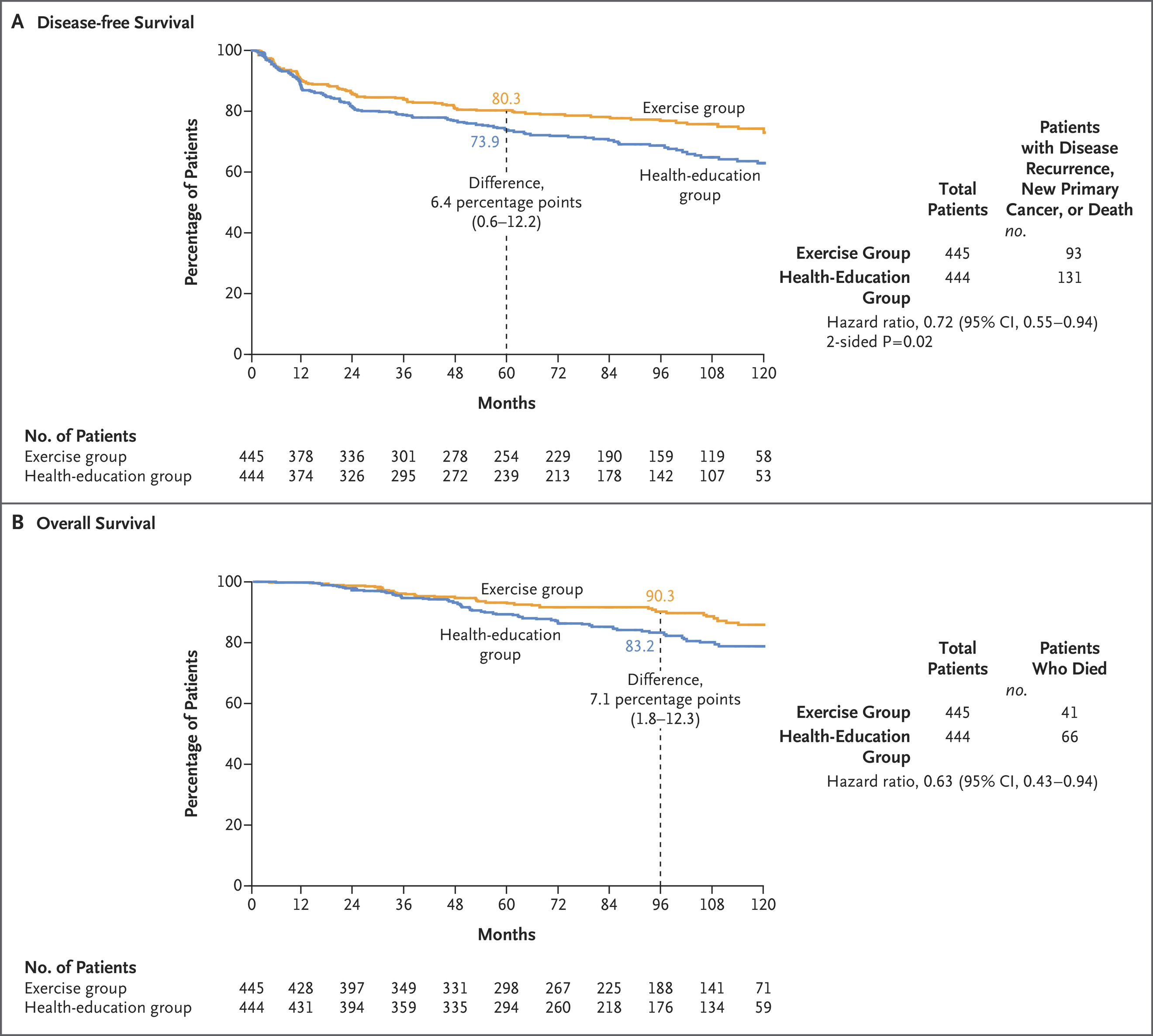
The CHALLENGE study revealed two landmark clinical victories:
1. 28% Lower Risk of Recurrence or Death: Disease-free survival—which specifically measures protection against cancer recurrence, the development of a new primary cancer, or death—was significantly higher in the structured exercise group (Hazard Ratio = 0.72; 95% CI).
2. 37% Lower Risk of Overall Death: The study demonstrated a substantial boost in long-term overall survival (Hazard Ratio = 0.63; 95% CI, 0.43 to 0.94).
Beyond these numbers lies an opportunity in how oncology views physical activity—not just as general wellness advice, but as a tool for longevity.
The leading hypotheses* as to why cancer responds to movement:
Lowers insulin: less of a potential growth signal for cancer cells (IGF-1)
Less inflammation: a calmer and more controlled immune environment
Stronger immune response: exercise may promote anti-tumor immune responses
*These remain hypotheses, they are not proven by this trial.
For decades, observational studies and laboratory research suggested that physical activity could improve outcomes for cancer patients. However, observational research can only identify correlations; it cannot definitively prove cause and effect.
The CHALLENGE study bridges this gap by delivering conclusive clinical evidence. It establishes that exercise suppresses cancer recurrence and directly improves post-treatment survival.
Understanding Adverse Events
Resuming physical activity after completing chemotherapy can occasionally lead to minor physical setbacks. The study demonstrated that physical activity is safe when approached with basic precautions, with physical soreness being overwhelmingly mild, temporary, and manageable.
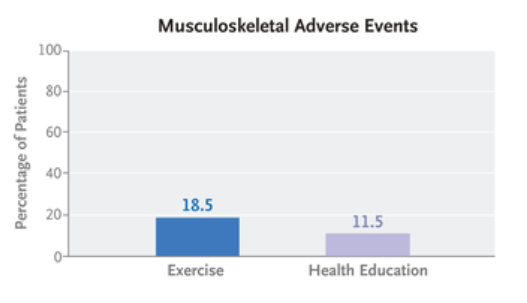
During the trial, musculoskeletal adverse events—such as temporary muscle soreness, minor tendon strain, or joint stiffness—occurred in 18.5% of participants in the exercise group compared to 11.5% in the health-education group.
Start Slow & Build Gradually: Begin with low-impact starter activities—such as structured daily walking programs or light supervised resistance sessions—to let muscles and joints adapt safely.
Consult Your Oncology Team: Partner with your doctor or a physical therapist to customize an activity plan that fits your exact stage of recovery and baseline fitness.
View Movement as Medicine: Treat physical activity as a core component of your post-chemotherapy plan that actively works to reduce the risk of cancer returning.
Seek Structure: Focus on structured, guided routines rather than relying solely on sporadic daily activity.
Focus on Long-Term Consistency: Maintain physical activity over multiple years to realize the full disease-free and overall survival benefits.
At Stretch Affect we are excited by this research and the proven power of physical activity to improve longevity outcomes in those with colon cancer. We pride ourselves on taking great care to create safe and structured plans for all of our clients, if you are looking for guidance from expert physical therapists, we are here for you. Your sessions with us are an hour long--no rushed 20 minute sessions--we are dedicated to getting you better.

Psst...if you made it this far, congratulations! You're clearly a master of fine print detection. Now, let's put those detective skills to good use and schedule a consultation call or reach out through the little buttons below.
Psst...if you made it this far, congratulations! You're clearly a master of fine print detection. Now, let's put those detective skills to good use and schedule a consultation call to see how this all works in real life.
